



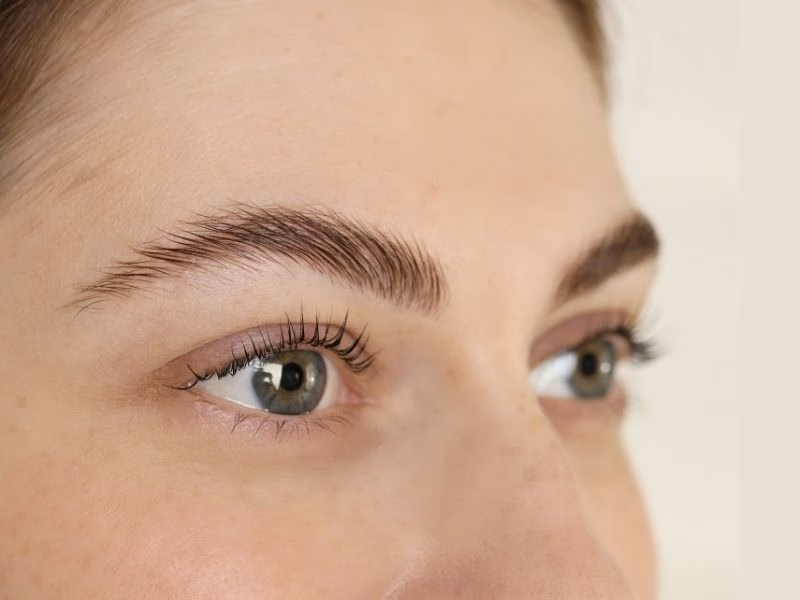
The temporal lift is a cosmetic surgical procedure that restores youthful shape to the eyes by lifting the outer corner of the eyebrow and the soft tissues located in the temple area where weight loss occurs due to ageing or gravity. Due to modern endoscopic techniques (commonly used in Turkey) that allow the release of the brow tail and surrounding tissue of the eyes via small incisions made in the hairline and then anchored to the periosteum, this will remove the tired or sad appearance of the face and will help reduce the heaviness at the corner of the eyes, providing a solid base for the “almond eye” or “angled eye” beauty ideal.
Contents
- What is temporal lift surgery?
- What are lateral brow lift surgery, midface lift and almond eyes?
- Temporal lift vs Lateral brow lift: Key Differences
- Benefits of Temporal Lift
- Temporal lift cost in Turkey, Istanbul
- The Temple Lift Procedure: Techniques and Approaches
- Combining Mid-face lift, Almond eyes, or Lateral brow lift
- Ideal Candidates for Temple Area Rejuvenating
- Temporal Lift Recovery Timeline and Aftercare
- Results and Longevity of Temporal Lift Surgery
- Risks and Complications of Temporal Lift
- Frequently Asked Questions
What is temporal lift surgery?
Consider a wrinkled bed sheet. When new, the sheet is smooth, flat and unblemished. Over time the bedsheet develops creases and sags downward. If you were to take one of the corners of that bedsheet and gently lift and stretch it outward and upward, all those wrinkles would disappear and the bedsheet would be flat again. The same thing happens with a temporal lift in the upper-lateral portion of the face.
We have to remember those traditional cosmetic surgeries that caused patients to appear as though they had been caught in a hurricane and their faces were being blown backward. A temporal lift is a much more focused and detailed cosmetic procedure that utilises a very specific and limited area of the upper-lateral portion of the face. The main goal of this type of surgery is to improve the “tail” of the eyebrow rather than the medial or inner corner of the eyebrow (the one closer to the nose).
Why only the tail?
Due to the anatomy of the eyebrow, the medial (inner) portion of the eyebrow has very strong muscles and ligaments that attach it to the bone; therefore, it is very difficult to move. The lateral, or “tail”, portion of the eyebrow has less structural support from the muscles and ligaments that anchor it to the bone. As we age, the volume of fat in the temple area begins to decrease, the supporting ligaments that hold the skin in place become lax and the brow tail begins to sag over the eyelid. This causes a “hooding” effect that causes the eyes to appear smaller than they really are and can cause a person’s gaze to appear depressed or unhappy. In some cases, the amount of sagging is so extreme that even eyeliner applied during makeup disappears under the skin that folds over the eyelid.
In contemporary Turkish aesthetic thinking, this type of procedure is performed for both rejuvenation of the facial structures and to create an aesthetically pleasing expression of the face. Popular names for this type of procedure include “Model Eyes”. These procedures slightly elevate the brow tail and pull it outward and upward to remove the congestion of the skin around the eyes, smooth out the deep lines of the crow’s feet and provide the individual with a more vibrant, awake and expressive gaze.
What are lateral brow lift surgery, midface lift and almond eyes?
When researching the world of aesthetics, it is easy to become overwhelmed by the number of terms used to describe different cosmetic procedures. Many of the terms used today are often used incorrectly or are misinterpreted. Therefore, when deciding whether or not to undergo a full makeover package in Turkey, it is essential to understand the differences between a lateral brow lift, a mid-face lift and almond eyes.
Let’s examine each procedure separately.
The lateral brow lift is often mistaken for a temporal lift; however, the two procedures differ significantly. A lateral brow lift specifically addresses a single concern: to physically raise the outer third of the eyebrow. The lateral brow lift is the most successful method of removing the heavy feeling that occurs in the upper eyelid.
How do I know which one is right for me?
The primary difference between a traditional brow lift and a lateral brow lift lies in the direction that the brow is lifted. In traditional brow lifts, the brow is simply raised vertically toward the hairline. A lateral brow lift, however, pulls the brow both diagonally upward and outward. Why is this important? Because pulling the brow upward will result in a permanent state of surprise. Pulling the brow both diagonally upward and outward will produce a natural arching of the eyebrows that is characteristic of an attractive female brow and a charismatic male gaze.
Mid-Face Lift
While the mid-face lift is sometimes referred to as a cheek lift, it is typically used to refer to a procedure that focuses on lifting the middle of the face, including the lower eyelids, cheeks and nasolabial fold. The purpose of this procedure is to restore the lost volume of the cheeks and mid-face area. Typically, this procedure is performed using a combination of fat injection/transfer and/or a mid-face lift.
Almond Eye
An almond eye is an extremely desirable facial feature. The almond eye is characterized by a slanting eye shape. While a true almond eye is naturally occurring, a surgeon may use a variety of techniques to create this appearance. These techniques include blepharoplasty, a brow lift, eyelid fat transfer, and/or eyelid fat injection.
Face Lift
Think of the face as a house, with the mid-face (cheeks and under-eyes) being the largest wall (front door). Classic facelifts target the base of the house (lower jaw and neck) and the roof (brow/forehead) but almost always miss the middle storey (mid-face). It is also the first place to show signs of ageing.
The cheek fat pads, which hang from the cheekbones when we’re younger, start to slide down toward the nose due to gravity as we get older. Two issues occur as a result of this downward migration: The space between the eyes and the lower eyelids becomes hollow and sunken, giving an exhausted appearance. The downward migration of the facial tissue also creates large creases (nasolabial folds) surrounding the nose. The mid-facial lift (commonly performed in Turkey as an endoscopic mid-facial lift) is lifting the fallen tissue of the mid-face (the walls of the building) back into its original location. As the cheeks are lifted, the hollowness under the eyes fills automatically, returning the face to its youthfulness and heart-shaped form.
Eye Almond Surgery (Canthoplasty)
Almond eye aesthetics aim to alter the geometric shape of the eye. The shape of the eye is determined by the location of the inner and outer corners of the eye. Canthoplasty aims to raise the outer corner of the eye relative to the inner corner, thereby imparting a slightly asymmetrical, exotic, and deeper look to the eye.
Canthoplasty can be done in two ways:
Permanent: A permanent change is achieved by cutting and sewing the ligament at the outer corner of the eye further onto the bone.
Temporary (Thread): Threads are used to support the eye without making any cuts in the ligament. This method is more preventative, has less of an immediate effect, but is reversible.
Temporal lift vs Lateral brow lift: Key Differences
You may see both of these terms together in promotional materials or on social media; however, in the operating room they are distinctly different. Where patients are frequently confused is that they believe these two procedures are equivalent. An understanding of the differences allows the patient to understand what he/she should expect from each procedure.
The first thing to note is the terminology difference.
Temporal lift typically denotes the surgeons’ access point (temples), and lateral brow lift denotes the destination (raising the brow). However, the greatest distinction between the two procedures occurs in their duration and depth.
Temporal lift procedures described as “lunchtime lifts” or “quick temporal lifts” are essentially limited to tightening the skin alone. By nature, skin is elastic and will therefore continue to relax regardless of how much tension is applied to it.
On the other hand,
Lateral brow lift extends much deeper than the skin, through the layer immediately above the bone. At this level, there exist strong ligaments that hold the brow down to the bone and secure it to the bone. The surgeon releases these ligaments. Like releasing a ship’s mooring lines, once these ligaments are released, the brow is now free and can be secured to the bone at a new, elevated level. The long-term effects of this deep plane procedure are expected to last many years since the weight is now borne by the rigid periosteum (bone membrane) rather than the stretchy skin.
To summarise simply: a temporal lift generally smoothes wrinkles in the skin of the forehead and minimises the appearance of crow’s feet, while a lateral brow lift permanently raises and sets the position of the eyebrow at a new height.
Benefits of Temporal Lift
Turkey’s increasing popularity in aesthetic surgery has led to a golden age for temporal lift. Why would someone choose to undergo a temporal lift instead of traditional treatments? There are a number of good reasons for this.
Invisible Scars
The largest concern with cosmetic surgery is looking like one has had work done or having visible scarring. The Temporal Lift is ideal in this regard. The incision is not made directly in front of the hairline but approximately 2-3 cm behind it. After the wound heals, the resulting scar will be a thin, nearly invisible line, hidden amongst the hair. Even if you wear your hair in a ponytail, or if it gets blown away by the wind, the fact that a temporal lift was performed will never be apparent.
Maintaining Your Natural Brow Shape
There is some historical precedent in old-fashioned brow lifts where a patient’s brow ends up looking like they’re always frowning or shocked. That is why the temporal lift does not touch your brow in the middle; the middle part of the brow is the part we use when we mimic expressions. Since the temporal lift doesn’t alter the brow in the middle section, only the tiredness is removed, and a healthy, energetic look is left behind.
Returning to Society Quickly
When comparing the trauma of this surgery to larger facelift surgeries, this surgery is much less invasive to the body. This surgery fits the “medical holiday” model. While there may be slight swelling, patients typically can wear stylish sunglasses and enjoy coffee on the street in Istanbul about a week after surgery, returning to society quickly.
Foundations for Popular Looks
If you wish to achieve popular trends such as “Fox Eyes” or “Bella Eyes”, the temporal lift is the foundation for achieving the look you desire. Regardless of how far you angle your eyes to appear exotic, if your eyebrows are low and pressing against your eyelids, the exotic look will never show. A temporal lift removes the heavy veil of the eyebrow across the eye so you can showcase the eye shape you desire.
Temporal lift cost in Turkey, Istanbul
Undoubtedly, one of the reasons why patients travel from abroad—especially Europe and America—to Turkey is primarily the cost savings. However, the term “affordable” cannot be misinterpreted here. Turkey offers competitive pricing, not because quality is poor, but because of lower general living costs compared to Western countries.
For the price of the surgeon’s fee alone in the West, you get a luxury healthcare experience in Turkey. In general, the Turkish medical tourism market operates with an “all-inclusive package” philosophy. This is a great benefit to foreign patients since they do not have to worry about any unexpected costs.
When you choose to purchase an all-inclusive package, you receive not only surgery but also a complete service. Luxury vehicles will transport you from the airport; accommodations will be provided in luxury hotels; hospital costs, postoperative medications, corsets, and translation services to assist in communication and eliminate potential language barriers are all included.
Of course prices vary depending upon several factors, including the surgeon’s experience and reputation, social media presence, the luxury segment of the clinic/hospital where the procedure is performed, and the technique(s) employed during the procedure. As an example, employing endoscopic techniques using advanced technology (camera systems) to perform a temporal lift is more expensive than traditional thread lifts; however, the results achieved with endoscopic techniques are significantly longer lasting. Combining a temporal lift with another procedure such as almond eye or a mid-face lift can also provide a significant advantage in terms of overall cost for the entire package of procedures. Procedural combinations that may be expensive to perform separately become much more cost-effective when bundled together in a single package.
The Temple Lift Procedure: Techniques and Approaches
A temporal lift is not a “one size fits all” surgical dress. Based on the patient’s facial anatomy, age and expectations, surgeons employ various techniques to customise each patient’s temporal lift surgery. Understanding the techniques allows patients to better understand what to expect.
Endoscopic Temporal Lift
This surgical method has been one of the greatest advancements in the field of aesthetic surgery thanks to technological advancements. Using thin instruments (with built-in cameras and light sources) inserted through small incisions made in the scalp, the surgeon can visualise every aspect of the operation on a large screen, including vessels, nerves, etc.
The benefits of this method include the fact that the surgeon is performing the operation under direct visualisation and can therefore release the ligaments holding the brow down and attach the soft tissues to their new location on the bone. Sometimes, temporary or permanent sutures are used to secure the attachments. These sutures provide the support needed for the most natural and long-lasting results possible.
Thread Lift Methods
Often referred to as “lunchtime lifting” or “quick sling”. This is actually a non-surgical procedure; a brow lift is achieved by inserting barbed threads under the skin and suspending the brow upward. Yes, this method is practical; there is little to no swelling, and you can resume your normal activities right away. However, similar to taping a poster to a wall, the threads will loosen over time; the threads can migrate through the tissue or lose their effectiveness. Threads can slip through the tissue or lose their effect. Longevity is limited to months and does not replace a true surgical transformation.
Combining Mid-face lift, Almond eyes, or Lateral brow lift
The most significant trend in aesthetic surgery today is a holistic approach. That means viewing the entire face as a whole unit rather than piecemeal. To illustrate, lifting the brows while leaving the cheeks sagging is like repairing the roof of a house while letting the walls crumble. Hence, surgeons in Turkey commonly suggest combined surgical procedures.
To exemplify, combining a mid-face lift with a temporal lift produces an exceptionally powerful result. In this procedure, accessed via the temple, the sagging cheek tissue is lifted upward. Thus, killing two birds with one stone: the sagging cheeks are gathered, and the under-eye hollows are naturally filled with the patient’s own tissue. Consequently, the fatigued expression on the face is completely erased.
In addition, almond eye surgery is a very popular component of this combination. As a consequence of lifting the brows, the eye area relaxes, thereby providing the perfect canvas for altering the eye shape. The lifted cheek tissue also provides support to the under-eye, thus allowing the new eye shape to stand more solidly. Furthermore, the above-mentioned combinations allow for a significantly more harmonious and dramatic rejuvenation during a single recovery period.
Ideal Candidates for Temple Area Rejuvenating
Individuals who apply for this type of surgery typically belong to one of two broad categories. The desires and needs of each category are quite distinct.
Those Seeking Rejuvenation (Ages 40+)
The primary motivation for this group is to return to their “old self.” In other words, when they gaze into the mirror, they notice skin piled onto their eyelids, deepened crow’s feet, and a perpetually fatigued expression. Thus, this surgery serves as a time machine. Their objective is not to alter their face but to regain the vigorous appearance they had approximately 10–15 years prior. Consequently, endoscopic techniques and midface combinations produce outstanding results for these patients.
Those Seeking Beautification and Image Change (Ages 20-30)
The primary motivations of this group are younger and are unaffected by signs of ageing. Their desire is for structural change. They wish to obtain those slanted, sharp, and exotic looks observed on social media. They wish to transform their naturally low-brow structure or round eyes into a more predatory and “snatched” form. For this group, the temporal lift is utilised in conjunction with almond eye aesthetics as a tool for designing their image.
It should be noted, however, that in some cases, this surgery may not be suitable for certain individuals. For example, for individuals with protruding (bulging) eyes or for those experiencing severe dry eye syndrome, this type of lifting can pose a risk to their eye health. It is therefore essential that a comprehensive examination be conducted prior to surgery.
Temporal Lift Recovery Timeline and Aftercare
Although the surgical process ends once the procedure finishes, the recovery journey has just begun. Understanding this process will help you to relieve anxiety.
The Initial Days: Patience Required
Upon discharge from surgery, you may be required to wear a tight bandage to minimise swelling. During the initial 2–3 days post-surgery, swelling will reach its peak. Feeling tension, a pulling sensation, and mild oedema in your eyes is normal. You may liken yourself to a character from the movie Avatar; this is temporary.
The First Week: Transformation Continues
Typically, stitches are removed approximately 1 week after surgery. By that point, if you have bruises, they will have begun to yellow and fade. At this point, most patients are able to wear their glasses and go out comfortably.
The “Alien” Stage
Perhaps the most interesting part of the recovery process occurs between weeks 2 and 3. Patients often call anxiously and say, “I look surprised! My Brows are Too High!” We call this overcorrection, and it is done intentionally. Since gravity will pull tissues down slightly as they heal, if we were to leave them at the optimal position on the operating table, the brows would drop back to their original position upon healing. Thus, that overly slanted appearance in the early stages of recovery is a natural component of the healing process and will resettle to the perfect level over time.
Post-Surgical Care Recommendations
Elevated sleeping position aids in the reduction of oedema. Protecting the skin from the sun is important for scar healing. In addition, skipping the eye drops prescribed by your doctor will result in dryness and irritation in the eyes.
Results and Longevity of Temporal Lift Surgery
Asking how long surgery lasts is the most valid and often asked question about the surgery.
It varies depending on the type of technique and lifestyle.
An endoscopic method has long-lasting results because it is a deep method and tissue is attached to the bone. Most patients can expect 5 to 10 years of results. Although, you must remember that surgery will not stop time from moving forward; it simply reverses it. As you continue to live and grow older, gravity will still exist; however, you will never return to your pre-surgical state; you will be in a better condition than at that point.
Thread lifts and/or simple skin excisions do not have long-lasting results. The threads will eventually dissolve, the skin will stretch, and the brows will eventually revert to their previous position, usually within 1 to 2 years. Other factors that will also shorten the length of time that results last include smoking, constant weight gain/loss, and excessive sun exposure.
Risks and Complications of Temporal Lift
Similar to all surgeries, temporal lifts come with risks associated with the procedure. Understanding the risks will help you make an informed decision.
The greatest risk to the patient is the damage to the nerve(s) running through this region that control the muscles responsible for brow movement. Damage to these nerves by inexperienced surgeons can lead to a permanent or temporary loss of brow movement. However, the risk of nerve damage is minimal with endoscopic methods because the surgeon is able to view the entire area via camera. Numbness and/or temporary inability to move the brow due to swelling can occur but will typically resolve itself within a few months.
Hair loss is another potential complication of temporal lifts. Hair follicles that are injured at the incision site can result in hair loss along that line. Surgeons take precautions to avoid injury to the hair follicle by making incisions parallel to the direction of the hair follicle.
Frequently Asked Questions
What is the difference between a temporal lift and a full facelift?
A temporal lift addresses only the top portion of the face, the upper section. This procedure targets the brows, temples, and eye area. A full facelift, on the other hand, addresses the foundational areas of the face and includes tightening the cheeks, jawline, and neck. If you are experiencing drooping in your neck or jowls, a temporal lift will not correct this problem.
Is a temporal lift painful?
Because you are under general anaesthesia during the procedure, you will experience no discomfort. After surgery, most patients report that the recovery process is not painful but uncomfortable. They describe it as pressure. Patients report feeling a very tight band around their head and/or someone applying pressure to their temples. This sensation is caused by the new positioning of the tissues and is easy to manage using over-the-counter pain relievers.
When can I return to work after a temporal lift?
If you perform work that involves sitting in front of a computer screen, you can return to work in approximately 4-5 days with some possible swelling. Once the sutures are removed (usually 7-10 days post-operatively) and bruising is less prominent, you can resume your normal social activities. However, it is recommended that you wait at least 2-3 weeks before returning to your regular fitness routine or heavy lifting to minimise increased blood pressure.
Will a temporal lift leave visible scars?
Fortunately, this is the best part of the procedure. Since the incisions made are internal to the scalp, it is nearly impossible to identify the incisions from the outside once they heal. Even when you comb your hair back, the fine white lines resulting from the incisions are obscured among your hair strands.
What is the best age for a temporal lift?
There is no biological age for this; there is a “need age”. In young people (20s), the goal is usually aesthetic concerns like having more slanted eyes, while in the middle-aged group (40 and above), the goal is erasing signs of ageing. The best results for rejuvenation are generally obtained in the 40s and 50s when the skin hasn’t yet completely lost its elasticity.